Noble (1377-99), Calais
Certifikát: NGC MS 64 6512306-011
Prodáno: 08. 11. 2023
Prodejní cena: 450 000 Kč - 700 000 Kč
Popis
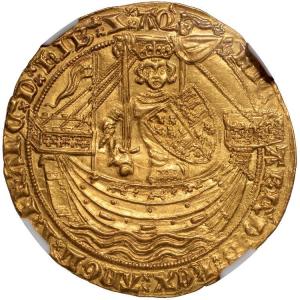
Richard II, noble (1377-99), Calais mint (voided quatrefoil over sail), crowned king in armour holding sword and royal shield, standing in ship, fluttering flag to his right, legend with French title, rev. floriated cross, lis at end of each limb, central compartment containing king’s initial ‘R’, lion passant in each angle, crown above, all within a tressure of eight arches, wt. 7.66 gms (S.1660; N.1306), certified and graded by NGC as Mint State 64, a fabulous specimen, as fine as we have seen, deeply struck and fully detailed on all motifs and letters of legends, the king’s face intricately detailed too, perfectly centred with much of the beaded reverse rim showing, lustrous with a beautiful gold colour—a gem of a noble
None graded higher.
Near the end of Edward III’s reign the minting of gold coins slowed appreciably, and this continued into Richard II’s reign—the result of a long-lasting war with France which was in constant need of funds as well as fewer imports of gold money that could be used as the basis of new English coins. In the last two years of Edward’s reign, 1376-77, the Tower Mint created only £180 in silver coins and £3,700 worth of gold money; the Calais mint in France struck only £450 worth of nobles in 1375. The new sovereign was only ten years old when he assumed the crown and there seems to have been some delay in minting his coins. Almost no specie, gold or silver, was arriving at his mints. At the same time, English money was being exported, and within the kingdom clipping had reduced the remaining coinage to fractions of its purported face value. This all left merchants and the public with so little money that Parliament pressured the king’s Council to place taxes on luxury goods, to be paid to the government in gold and/or silver in order to increase the supply of useful money. In large measure, these problems of the day explain the rarity of Richard II’s coins despite the fact that his reign lasted 22 years. The heady days of Edward III became a memory.
Richard’s portrait on silver coinage changed not at all, following tradition begun under Edward I in 1280 when he rejected any attempt by his mint to present a lifelike portrait. On the gold noble and its fractions, the new king’s name in Latin was changed, otherwise the coins remained identical. At times, reverse dies showing Edward’s initial remained in use for Richard. To denote coins struck at Calais (its gold ore supplied by merchants trading with Flanders), a fluttering flag was added to the ship’s stern. The smallest silver coins were made in greater quantities because they were sorely needed by common folk, and this accounts for the rarity of groats, the higher-value silver coin. Richard married the young daughter of the French king, Charles VI, resulting in peace in October 1396. A small number of his late gold and silver issues omit his French title as a result of the peace treaty, and to some extent this act revitalized the mint at Calais. As a class, nobles minted at Calais are perceptively rarer than those issued by the Tower.
None graded higher.
Near the end of Edward III’s reign the minting of gold coins slowed appreciably, and this continued into Richard II’s reign—the result of a long-lasting war with France which was in constant need of funds as well as fewer imports of gold money that could be used as the basis of new English coins. In the last two years of Edward’s reign, 1376-77, the Tower Mint created only £180 in silver coins and £3,700 worth of gold money; the Calais mint in France struck only £450 worth of nobles in 1375. The new sovereign was only ten years old when he assumed the crown and there seems to have been some delay in minting his coins. Almost no specie, gold or silver, was arriving at his mints. At the same time, English money was being exported, and within the kingdom clipping had reduced the remaining coinage to fractions of its purported face value. This all left merchants and the public with so little money that Parliament pressured the king’s Council to place taxes on luxury goods, to be paid to the government in gold and/or silver in order to increase the supply of useful money. In large measure, these problems of the day explain the rarity of Richard II’s coins despite the fact that his reign lasted 22 years. The heady days of Edward III became a memory.
Richard’s portrait on silver coinage changed not at all, following tradition begun under Edward I in 1280 when he rejected any attempt by his mint to present a lifelike portrait. On the gold noble and its fractions, the new king’s name in Latin was changed, otherwise the coins remained identical. At times, reverse dies showing Edward’s initial remained in use for Richard. To denote coins struck at Calais (its gold ore supplied by merchants trading with Flanders), a fluttering flag was added to the ship’s stern. The smallest silver coins were made in greater quantities because they were sorely needed by common folk, and this accounts for the rarity of groats, the higher-value silver coin. Richard married the young daughter of the French king, Charles VI, resulting in peace in October 1396. A small number of his late gold and silver issues omit his French title as a result of the peace treaty, and to some extent this act revitalized the mint at Calais. As a class, nobles minted at Calais are perceptively rarer than those issued by the Tower.